
Retrofit Design · Structural Strengthening

Seismic Retrofitting and Structural Strengthening for California Buildings.

PE-stamped retrofit design from a structural engineering firm — soft-story wood-frame, unreinforced masonry, non-ductile concrete, tilt-up, and steel. Ordinance-compliant drawings any qualified contractor can build from.

By Building Type

Common retrofit scopes across California construction.

Each typology fails in characteristic ways under seismic load. We start with what your building actually is, not a generic detail.

01 · Wood-Frame
Soft-Story

Soft-Story Wood-Frame

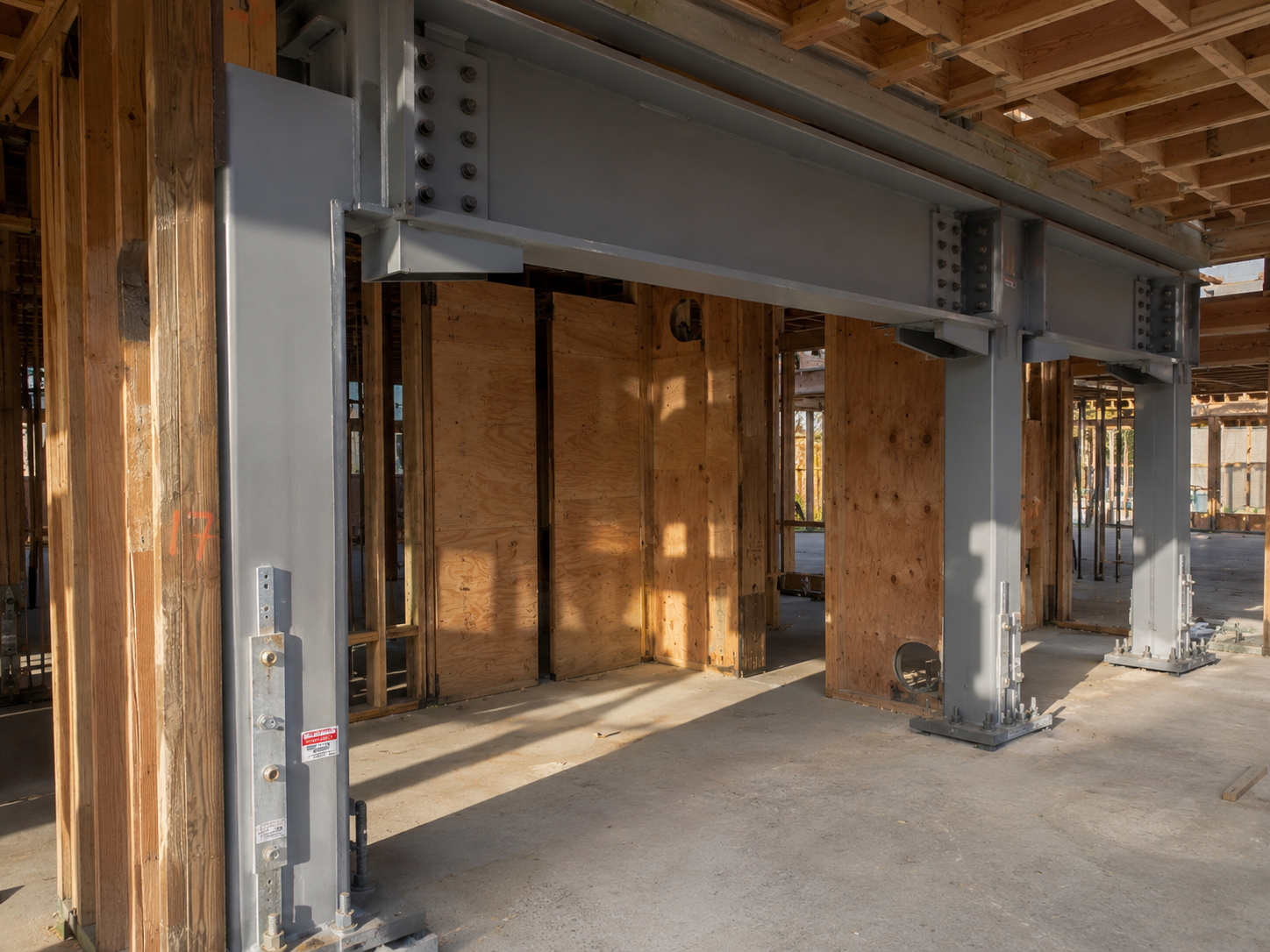
Open ground floors below multi-family residential — the highest-priority typology in San Francisco and Oakland ordinances. Steel moment frames, plywood shear walls, hold-downs, and continuity straps designed to ASCE 41 performance objectives.

02 · Masonry
URM

Unreinforced Masonry (URM)

Pre-1933 brick buildings remain across many California cities. Roof-to-wall ties, parapet bracing, diaphragm strengthening, and supplemental shear walls or moment frames where needed.

03 · Concrete
Non-Ductile

Non-Ductile Concrete

Pre-1976 concrete frame and wall buildings, including the LA non-ductile ordinance scope. Column jacketing, supplemental shear walls, and FRP confinement strategies engineered for the load path that matters.

04 · Tilt-Up & Steel
Industrial / Commercial

Tilt-Up & Steel-Framed

Roof diaphragm strengthening and wall anchorage upgrades for concrete tilt-up. Connection and brace retrofits for steel-framed warehouses, offices, and mixed-use podiums.

Techniques in the Toolbox

Engineering choices, not catalog parts.

The right retrofit minimizes disruption, respects budget, and meets the performance objective. We pick from the full toolbox per project.

Supplemental Shear Walls

Plywood, steel-plate, and concrete shear walls placed to correct torsional irregularities and increase capacity along weak axes.

Steel Moment & Braced Frames

For soft-story openings where shear walls would block circulation. SMRF and BRBF detailing per AISC 341.

FRP Wrapping & Confinement

Fiber-reinforced polymer for column confinement, beam shear, and slab flexural upgrades — where speed and minimal mass addition matter.

Diaphragm & Connection Upgrades

Roof and floor diaphragm strengthening, wall-to-diaphragm ties, and continuity hardware — often the highest-leverage moves.

Process

From evaluation to construction administration.

Most retrofits begin with an ASCE 41 evaluation. From there, design, permit, and field support flow through the same engineering desk.

  1. 01

    Evaluation or Drawing Review

    Start from an existing evaluation or drawing set. If neither exists, we perform measured documentation and a Tier 1 / Tier 2 evaluation as a foundation.

  2. 02

    Retrofit Strategy & Concept Design

    Iterate on the strategy with the owner — performance objective, budget, disruption tolerance. Concept-level drawings and order-of-magnitude cost picture.

  3. 03

    Permit Drawings & Specifications

    Full PE-stamped drawings and specifications suitable for permit and bid. We design; you select the contractor.

  4. 04

    Permit & Bid Support

    Response to plan-check comments, contractor RFIs during bid, and clarifications. We stay involved through award.

  5. 05

    Construction Administration

    Submittal review, RFI management, periodic field observation, and special-inspection coordination through completion and certificate of occupancy.

FAQ

Common questions.

Which California cities have mandatory retrofit ordinances?

San Francisco, Oakland, Berkeley, Los Angeles, Santa Monica, and West Hollywood have published mandatory ordinances covering some combination of soft-story, URM, and non-ductile concrete buildings. Compliance deadlines vary by tier and building type. We'll confirm your obligations during scoping.

Do we need to vacate during retrofit?

Often, no. Most wood-frame soft-story and many URM retrofits can be staged to keep tenants in place. Heavy concrete work or major shear wall placement may require partial vacancy. Strategy is part of the concept-design conversation.

How long does design take?

Concept design: 2–4 weeks. Permit set: 4–10 weeks depending on building complexity. Permit review is jurisdiction-dependent.

Do you have a preferred contractor?

No — and that's intentional. We design; we don't contract. The owner runs an open bid; we provide referrals on request but maintain engineering independence.

Can retrofit cost be funded?

Various California programs (PACE financing, soft-story matching grants in some cities, CMBS escrow set-asides) can fund retrofit. We'll flag what applies to your jurisdiction.

Get in Touch

We’re here to answer questions or start your project — send us your details today.

Free 15-minute consultation, no obligation. You’ll get a written scope and fee estimate from a licensed California PE within one business day.

Office
Dublin, CA 94568
Hours
Mon–Fri · 8:00am–5:00pm PT
Response
Within one business day

By sending this you’ll receive a written scope and fee estimate within one business day. We don’t share your details.